An administrator added a new disk to expand the current storage. Which of the following commands should the administrator run first to add the new disk to the LVM?
Correct Answer:C Comprehensive and Detailed Explanation From Exact Extract: To add a new physical disk to LVM, the disk must first be initialized as a physical volume using the pvcreate command. This prepares the new disk for use by the LVM subsystem. After initializing with pvcreate, you would use vgextend to add the new physical volume to an existing volume group. Other options: * A.vgextend adds a physical volume to a volume group, but you must use pvcreate first. * B.lvextend is used to increase the size of a logical volume, not to add a new disk. * D.pvresize is used to resize an existing physical volume, not to create one. [Reference:, CompTIA Linux+ Study Guide: Exam XK0-006, Sybex, Chapter 7: "Managing Storage", Section: "Managing Logical Volumes", CompTIA Linux+ XK0-006 Objectives, Domain 4.0: Storage and Filesystems, , ]
Question 12
Which of the following commands should an administrator use to see a full hardware inventory of a Linux system?
Correct Answer:A Hardware inventory and system information gathering are core responsibilities in Linux system management and are explicitly covered in CompTIA Linux+ V8 objectives. Among the listed commands, dmidecode is the most comprehensive tool for retrieving detailed hardware inventory information. The dmidecode command reads data directly from the system??s DMI (Desktop Management Interface) / SMBIOS tables, which are provided by the system firmware (BIOS or UEFI). It reports detailed information about system hardware components, including motherboard details, BIOS version, system manufacturer, CPU sockets, memory slots, installed RAM modules, serial numbers, and asset tags. This makes it the preferred tool when a full hardware inventory is required. The other options provide only partial or specific information. lsmod lists currently loaded kernel modules and does not provide physical hardware inventory. dmesg displays kernel ring buffer messages, which may include hardware detection logs but are not structured or complete inventory data. lscpu reports CPU architecture and processor details only, not the entire system hardware. Linux+ V8 documentation highlights dmidecode as the authoritative utility for system hardware discovery and inventory auditing. It is commonly used in enterprise environments for documentation, troubleshooting, capacity planning, and compliance reporting. Because it provides the most complete and authoritative hardware information available from the system firmware, the correct answer is A. dmidecode.
Question 13
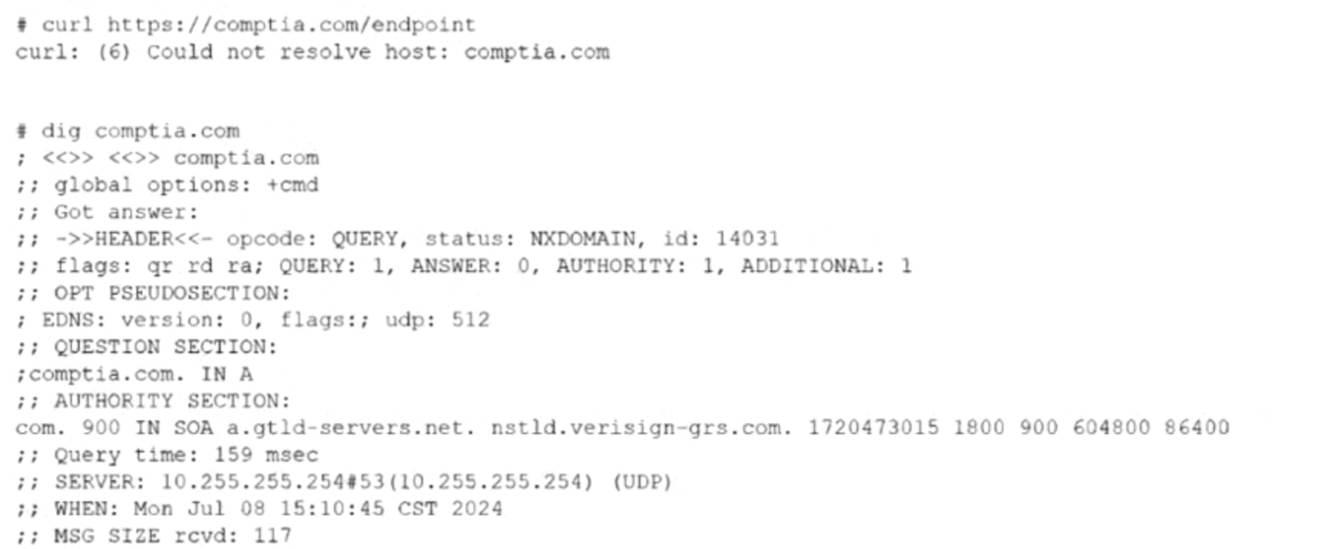
A systems administrator is having issues with a third-party API endpoint. The administrator receives the following output: Which of the following actions should the administrator take to resolve the issue?
Correct Answer:C
Question 14
A Linux systems administrator needs to extract the contents of a file named /home/dev/web.bkp to the /var/www/html/ directory. Which of the following commands should the administrator use?
Correct Answer:B Comprehensive and Detailed 250 to 350 words of Explanation From Linux+ V8 documents: File extraction and backup restoration are fundamentalSystem Managementtasks covered in CompTIA Linux+ V8. In this scenario, the administrator must extract the contents of an existing backup file into a target directory. The correct command isoption B, which uses cpio in extract mode. The command changes into the destination directory (/var/www/html/) using pushd, extracts the archive contents with cpio -idv, and then returns to the original directory with popd. This ensures that files are restored into the correct location without modifying paths inside the archive. The cpio utility is commonly used for backups created with cpio -o and supports reading archive data from standard input. Linux+ V8 documentation includes cpio as a valid and supported archive format for backup and restore operations. The other options are incorrect. OptionAincorrectly assumes the backup is a gzip-compressed tar archive. OptionCcreates a new archive instead of extracting one. OptionDassumes the file is a ZIP archive, which is not indicated by the .bkp extension. Linux+ V8 emphasizes using the correct tool based on the archive format and restoring files into the intended directory. Therefore, the correct answer isB.
Question 15
A Linux user needs to download the latest Debian image from a Docker repository. Which of the following commands makes this task possible?
Correct Answer:B Container management and image handling are part of modern Linux automation practices covered in CompTIA Linux+ V8. Docker images are stored in container registries such as Docker Hub, and administrators commonly need to download images to deploy containers. The correct command for downloading an image from a Docker repository is docker image pull. This command retrieves the specified image from a configured container registry and stores it locally. When no tag is specified, Docker automatically pulls the latest available version of the image. Therefore, docker image pull debian downloads the most recent Debian image from Docker Hub. The other options are incorrect. docker image init is not a valid Docker command and does not exist in Docker??s CLI. docker image import is used to create a Docker image from a tarball file, not to download an image from a repository. docker image save exports an existing local image into a tar archive and does not retrieve images from a remote registry. Linux+ V8 documentation emphasizes understanding container image lifecycles, including pulling, tagging, and running images. Pulling images is a foundational step before container execution and automation workflows. Therefore, the correct answer is B. docker image pull debian.