No Installation Required, Instantly Prepare for the XK0-006 exam and please click the below link to start the XK0-006 Exam Simulator with a real XK0-006 practice exam questions.
Use directly our on-line XK0-006 exam dumps materials and try our Testing Engine to pass the XK0-006 which is always updated.
Exam Code: XK0-006
Exam Title: CompTIA Linux+ Exam
Vendor: CompTIA
Exam Questions: 82
Last Updated: September 13th,2026
Question 1
A Linux administrator is making changes to local files that are part of a Git repository. The administrator needs to retrieve changes from the remote Git repository. Which of the following commands should the administrator use to save the local modifications for later review?
Correct Answer:A In Git-based workflows, especially those used in DevOps environments, it is common for administrators to have uncommitted local changes while needing to retrieve updates from a remote repository. Linux+ V8 emphasizes understanding how to safely manage local modifications during synchronization operations. The command git stash is specifically designed for this scenario. It temporarily saves (or ??stashes??) local changes in a stack-like structure and reverts the working directory to a clean state that matches the current HEAD. This allows the administrator to perform operations such as git pull without conflicts. Later, the stashed changes can be reapplied using git stash apply or git stash pop. The other options are incorrect. git pull retrieves and merges remote changes but will fail or cause conflicts if local modifications exist. git merge combines branches and does not save uncommitted changes. git fetch downloads remote references but does not address local working directory changes. Linux+ V8 documentation highlights git stash as a safe and reversible way to protect local work during repository updates. Therefore, the correct answer is A.
Question 2
Which of the following cryptographic functions ensures a hard drive is encrypted when not in use?
Correct Answer:B Disk encryption is a key Linux+ V8 security objective, especially for protecting data at rest.LUKS (Linux Unified Key Setup)is the standard Linux framework for full-disk and partition-level encryption. OptionBis correct. LUKS provides strong encryption for storage devices, ensuring that data remains unreadable when the system is powered off or the disk is removed. It integrates with tools like cryptsetup and supports key management, passphrases, and multiple unlock methods. The other options are incorrect. GPG encrypts files, not entire disks. PKI certificates are used for identity and trust, not disk encryption. OpenSSL is a cryptographic library, not a disk encryption mechanism. Linux+ V8 documentation explicitly identifies LUKS as the primary solution for disk encryption on Linux systems. Therefore, the correct answer isB.
Question 3
An administrator needs to verify the user ID, home directory, and assigned shell for the user named "accounting." Which of the following commands should the administrator use to retrieve this information?
Correct Answer:A User account information is centrally stored in the system??s account databases, and Linux+ V8 emphasizes the use of standard tools to query this data safely and consistently. The getent passwd accounting command retrieves the user??s entry from thepasswd database, which may be sourced from local files or network services such as LDAP. This entry includes the username, user ID (UID), group ID (GID), home directory, and assigned login shell. Therefore, optionAprovides all the requested information in a single command. OptionB, id accounting, displays the UID and group memberships but does not show the home directory or assigned shell. OptionCis incorrect because /etc/shadow contains password hashes and expiration data, not shell or home directory information. OptionD, who accounting, only shows login sessions and does not provide account configuration details. Linux+ V8 documentation highlights getent passwd as the preferred method for retrieving comprehensive user account information because it works across different authentication backends. Thus, the correct answer isA.
Question 4
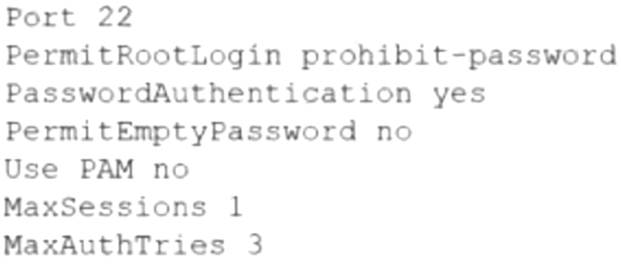
A Linux administrator attempts to log in to a server over SSH as root and receives the following error message: Permission denied, please try again. The administrator is able to log in to the console of the server directly with root and confirms the password is correct. The administrator reviews the configuration of the SSH service and gets the following output: Based on the above output, which of the following will most likely allow the administrator to log in over SSH to the server?
Correct Answer:D The SSH configuration option PermitRootLogin prohibit-password prevents the root user from logging in with password authentication. This setting means root cannot use a password to log in via SSH; only key- based authentication is permitted for root. The administrator can still log in as root locally, which is not affected by this SSH configuration. To allow SSH access as root, the administrator must use an SSH key instead of a password. Other options: * A. MaxSessions controls the number of simultaneous SSH sessions but is not causing the login denial here. * B. PAM (Pluggable Authentication Modules) is disabled, but enabling it is not required for basic SSH authentication. * C. Changing the SSH port is unrelated to the authentication method issue. Reference: CompTIA Linux+ Study Guide: Exam XK0-006, Sybex, Chapter 11: "Securing Linux", Section: "Securing SSH Access" CompTIA Linux+ XK0-006 Objectives, Domain 3.0: Security
Question 5
A Linux software developer wants to use AI to optimize source code used in a commercial product. Which of the following steps should the developer take first?
Correct Answer:B Linux+ V8 emphasizessecurity, compliance, and governancewhen introducing new automation technologies, including AI. Before using AI tools to optimize commercial source code, the developer must ensure that such usage complies with organizational policies. OptionBis correct because verifying company policy is the first and most critical step. AI tools may introduce risks such as intellectual property leakage, licensing conflicts, or regulatory violations. Many organizations restrict how source code can be shared with external systems, including AI services. The other options are premature. Selecting tools or deploying models should only occur after policy approval. Linux+ V8 highlights governance-first approaches when adopting automation technologies. Therefore, the correct answer isB.