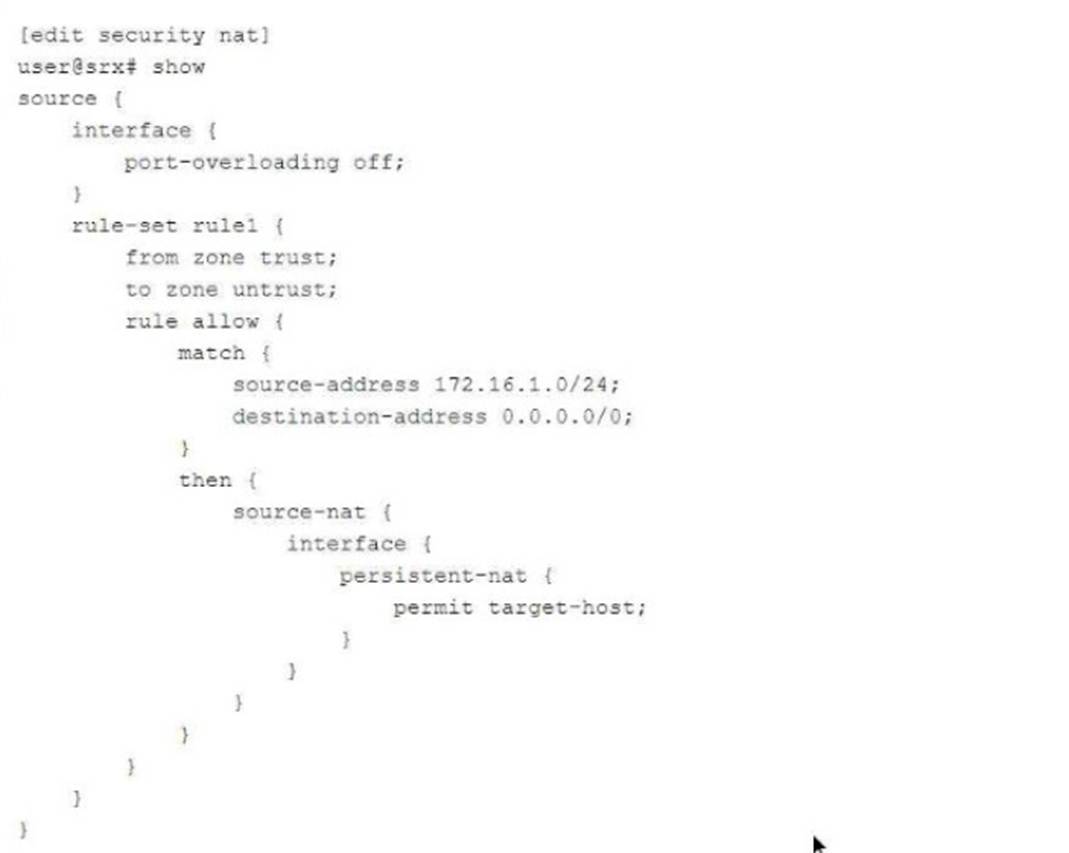
Referring to the exhibit, which two statements are correct about the NAT configuration? (Choose two.)
Correct Answer:AB
Question 12
You want to create a connection for communication between tenant systems without using physical revenue ports on the SRX Series device. What are two ways to accomplish this task? (Choose two.)
Correct Answer:BD
Question 13
Which two statements are true regarding NAT64? (Choose two.)
Correct Answer:AD Comprehensive Detailed Step-by-Step Explanation with All Juniper Security References Understanding NAT64: ✑ NAT64 allows IPv6-only clients to communicate with IPv4 servers by translating IPv6 addresses to IPv4 addresses and vice versa. ✑ It is essential in environments where IPv6 clients need access to IPv4 resources. Flow-Based vs. Packet-Based Forwarding Modes: ✑ Flow-Based Forwarding Mode: ✑ Packet-Based Forwarding Mode: ✑ Option A: An SRX Series device should be in flow-based forwarding mode for IPv4. ✑ Option B: An SRX Series device should be in packet-based forwarding mode for IPv4. ✑ Option C: An SRX Series device should be in packet-based forwarding mode for IPv6. ✑ Option D: An SRX Series device should be in flow-based forwarding mode for IPv6. Key Points: ✑ NAT64 Requires Flow-Based Mode: ✑ Packet-Based Mode Limitations: Juniper Security References: ✑ Juniper Networks Documentation: ✑ Understanding Flow-Based and Packet-Based Modes: Conclusion: ✑ To implement NAT64 on an SRX Series device, both IPv4 and IPv6 traffic must be processed in flow-based forwarding mode. ✑ Therefore, Options A and D are the correct statements.
Question 14
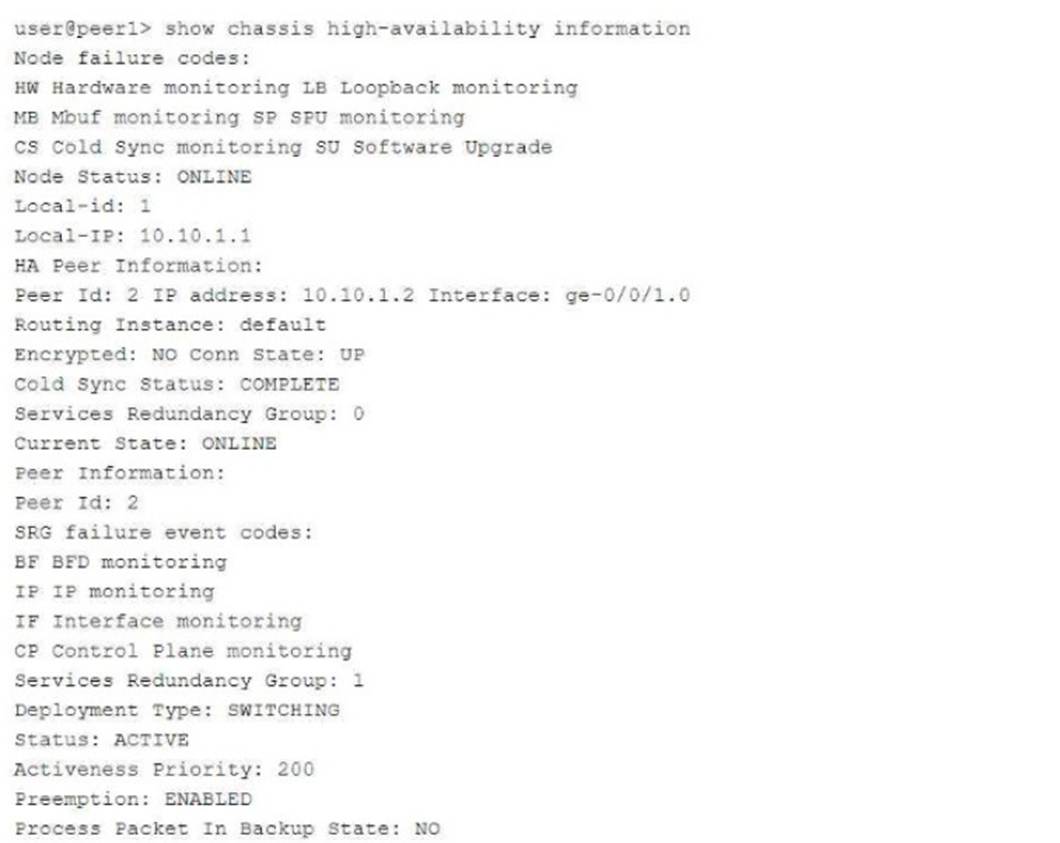
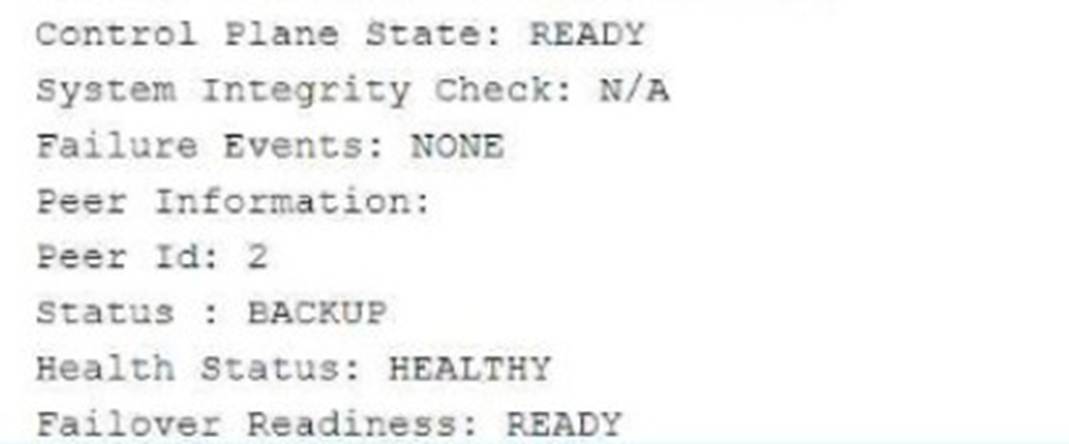
Exhibit: Referring to the exhibit, which statement is true?
Correct Answer:D The exhibit describes a Chassis Cluster configuration with high availability (HA) settings. The key information is related to Service Redundancy Group 1 (SRG1) and its failover behavior between the two peers. ✑ Explanation of Answer D (Packet Forwarding after Failover): Juniper Security Reference: ✑ Chassis Cluster Failover Behavior: When a service redundancy group fails over to the backup peer, the previously active peer forwards traffic to the new active node. Reference: Juniper Chassis Cluster Documentation. ==========
Question 15
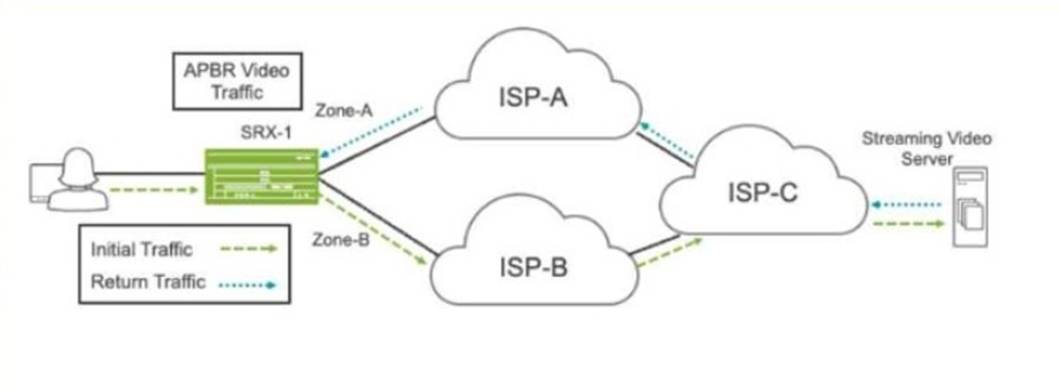
Exhibit: Referring to the exhibit, a default static route on SRX-1 sends all traffic to ISP-A. You have configured APBR to send all requests for streaming video traffic to ISP-B. However, the return traffic from the streaming video server is coming through ISP-A, and the traffic is being dropped by SRX-1. You can only make changes on SRX-1. How do you solve this problem?