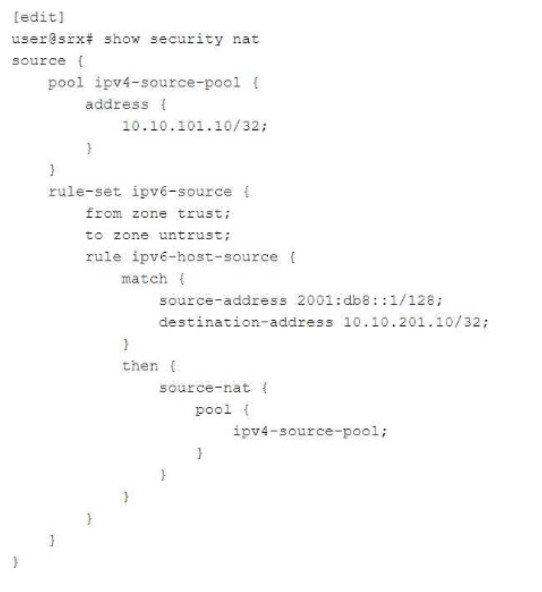
Exhibit: You are configuring NAT64 on your SRX Series device. You have committed the configuration shown in the exhibit. Unfortunately, the communication with the 10.10.201.10 server is not working. You have verified that the interfaces, security zones, and security policies are all correctly configured. In this scenario, which action will solve this issue?
Correct Answer:D
Question 7
You are setting up multinode HA for redundancy. Which two statements are correct in this scenario? (Choose two.)
Correct Answer:AC Comprehensive Detailed Step-by-Step Explanation with All Juniper Security References Understanding Multinode HA: ✑ Chassis Cluster in Active/Passive Mode: ✑ Dynamic Routing Protocols: Option A: Dynamic routing is active on one device at a time. ✑ Explanation: Reference: "In a chassis cluster, the primary node handles all control plane tasks, including dynamic routing." Source: Juniper TechLibrary - Chassis Cluster Overview Option C: Physical connections are used for the control and fabric links. * Explanation: Control and fabric links are direct physical connections between cluster nodes. Reference: "The control and fabric links must be connected using physical interfaces between the nodes." Source: Juniper TechLibrary - Chassis Cluster Components Why Options B and D are Incorrect: Option B: Dynamic routing is not active on both devices simultaneously in active/passive mode. Option D: The Inter-Cluster Link (ICL) uses Layer 2 connectivity, not Layer 3. Conclusion: The correct options are A and C.
Question 8
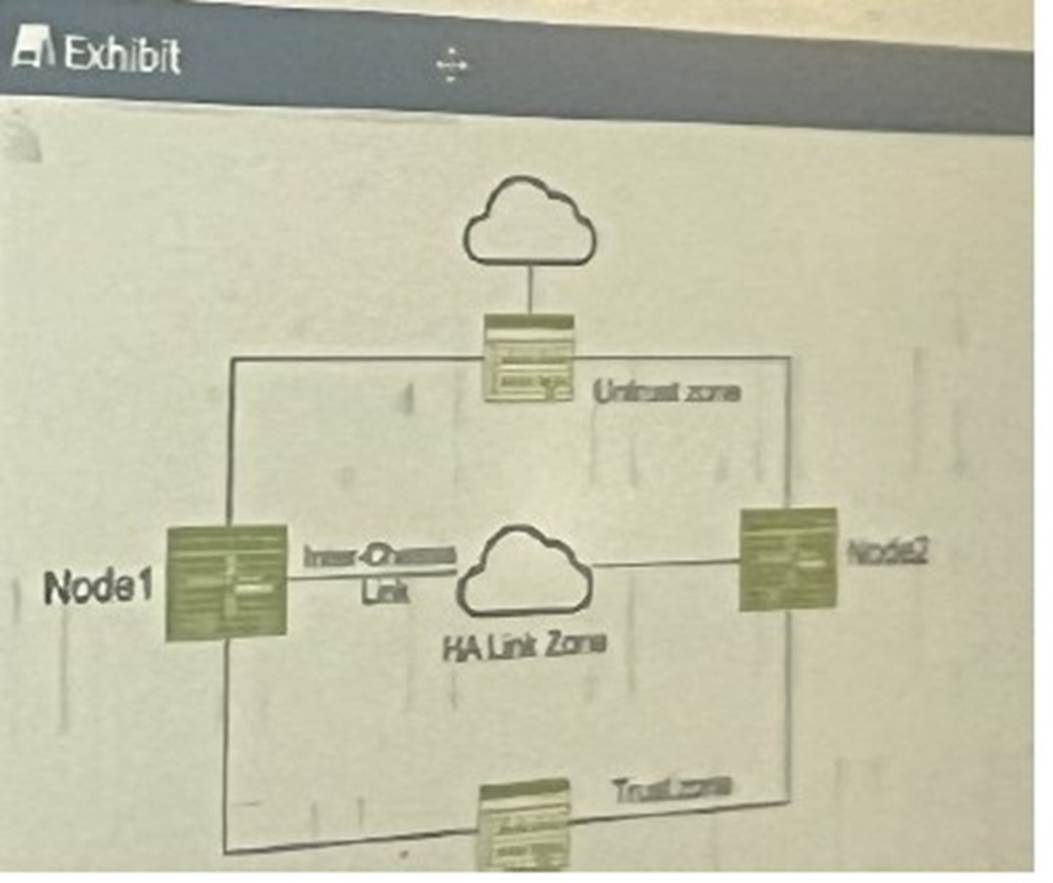
Exhibit: You have deployed a pair of SRX series devices in a multimode HA environment. You need to enable IPsec encryption on the interchassis link. Referring to the exhibit, which three steps are required to enable ICL encryption? (Choose three.)
Correct Answer:ACD ✑ A. Install the Junos IKE package on both nodes. While I previously stated that IKE is usually included in the base Junos OS image, it's essential to ensure that the necessary IKE package is indeed installed and enabled on both SRX nodes to support ICL encryption. ✑ C. Configure a VPN profile for the HA traffic and apply it to both nodes. This dedicated VPN profile defines the security parameters (encryption algorithms, authentication, etc.) specifically for the ICL traffic. ✑ D. Enable HA link encryption in the IPsec profile on both nodes. Within the IPsec profile, you must explicitly enable ICL encryption to ensure that all traffic traversing the interchassis link is protected. Why E is incorrect: ✑ E. Enable HA link encryption in the IKE profile on both nodes. While securing IKE negotiations is important, it's typically handled within the IPsec profile itself when configuring ICL encryption on SRX devices.
Question 9
What are three core components for enabling advanced policy-based routing? (Choose three.)
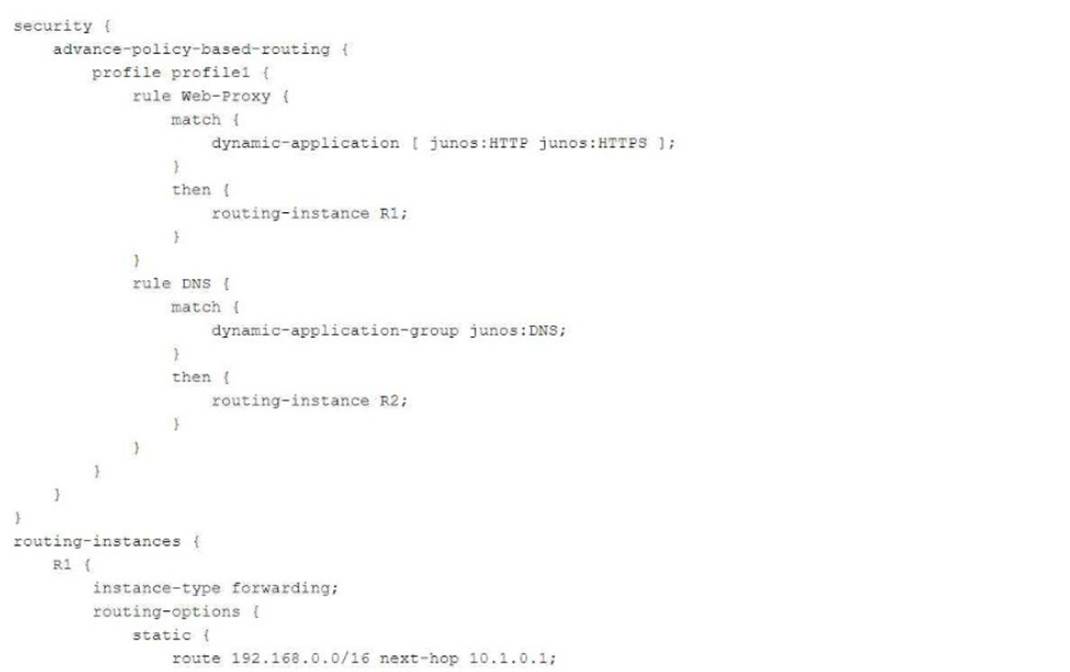
Correct Answer:ACD To enable Advanced Policy-Based Routing (APBR) on SRX Series devices, three key components are necessary: filter-based forwarding, routing instances, and APBR profiles. Filter-based forwarding is utilized to direct specific traffic flows to a routing instance based on criteria set by a policy. Routing instances allow the traffic to be managed independently of the main routing table, and APBR profiles define how and when traffic should be forwarded. These elements ensure that APBR is flexible and tailored to the network??s requirements. Refer to Juniper's APBR Documentation for more details. Advanced policy-based routing (APBR) in Juniper's SRX devices allows the selection of different paths for traffic based on policies, rather than relying purely on routing tables. To enable APBR, the following core components are required: ✑ Filter-based Forwarding (Answer A): Filter-based forwarding (FBF) is a technique used to forward traffic based on policies rather than the default routing table. It is essential for enabling APBR, as it helps match traffic based on filters and directs it to specific routes. Configuration Example: bash set firewall family inet filter FBF match-term source-address 192.168.1.0/24 set firewall family inet filter FBF then routing-instance custom-routing-instance ✑ Routing Instance (Answer C): A routing instance is required to define the separate routing table used by APBR. You can create multiple routing instances and assign traffic to these instances based on policies. The traffic will then use the routes defined within the specific routing instance. Configuration Example: bash set routing-instances custom-routing-instance instance-type forwarding set routing-instances custom-routing-instance routing-options static route 0.0.0.0/0 next- hop 10.10.10.1 ✑ APBR Profile (Answer D): The APBR profile defines the rules and policies for advanced policy-based routing. It allows you to set up conditions such as traffic type, source/destination address, and port, and then assign actions such as redirecting traffic to specific routing instances. Configuration Example: bash set security forwarding-options advanced-policy-based-routing profile apbr-profile match application http set security forwarding-options advanced-policy-based-routing profile apbr-profile then routing-instance custom-routing-instance Other Components: ✑ Routing Options (Answer B) are not a core component of APBR, as routing options define the general behavior of the routing table and protocols. However, APBR works by overriding these default routing behaviors using policies. ✑ Policies (Answer E) are crucial in many network configurations but are not a core component of enabling APBR. APBR specifically relies on profiles rather than standard security policies. Juniper Security Reference: ✑ Advanced Policy-Based Routing (APBR): Juniper??s APBR is a powerful tool that allows routing based on specific traffic characteristics rather than relying on static routing tables. APBR ensures that specific types of traffic can take alternate paths based on business or network needs. Reference: Juniper Networks APBR Documentation. ==========
Question 10
Referring to the exhibit, which statement about TLS 1.2 traffic is correct?